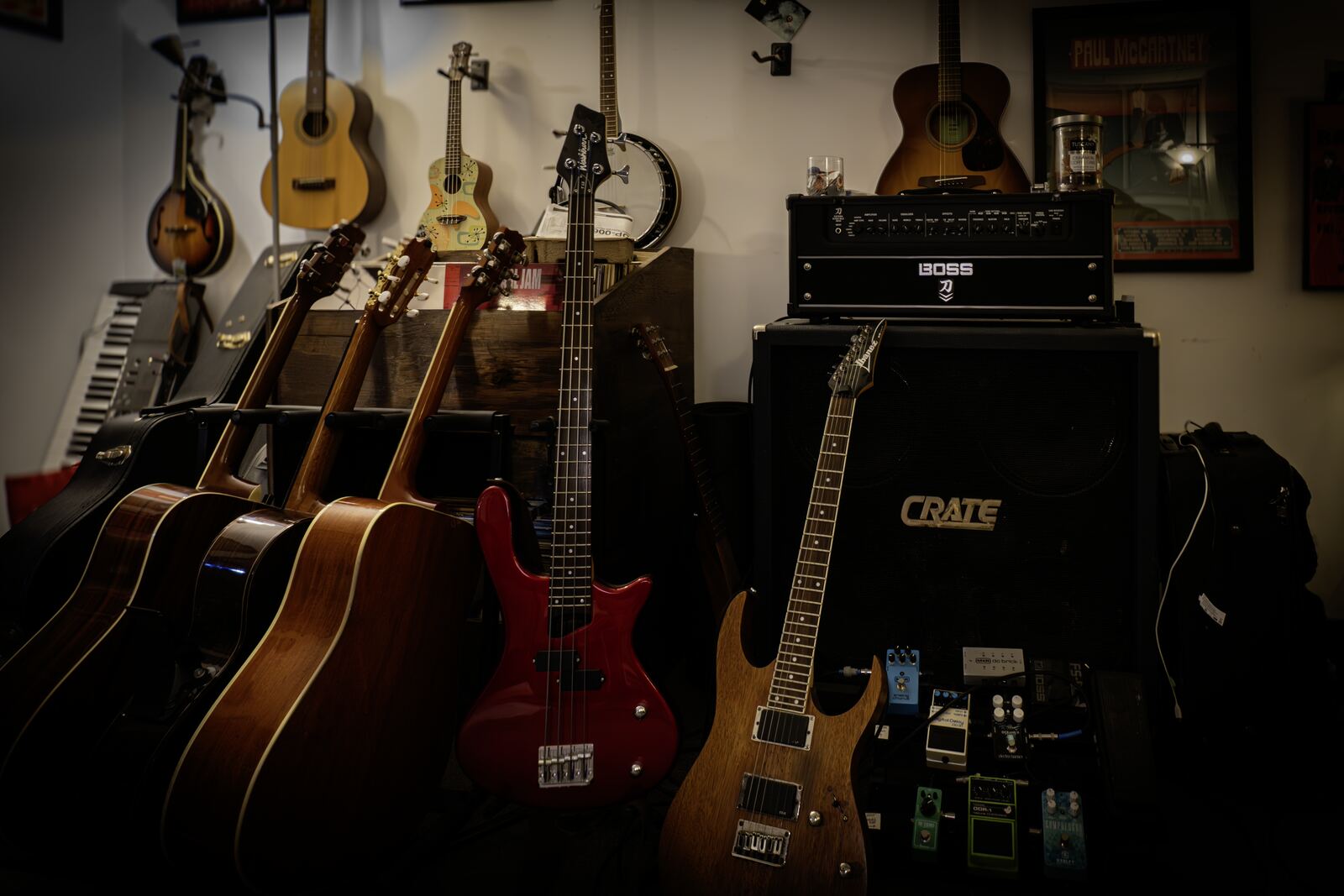
Children's guitars are sold in fractional sizes: 1/4, 1/2, 3/4 and full size. The fraction is a size class, not an exact proportion: each step down has a shorter scale, a smaller body and usually a slightly narrower neck.
Age is only a starting point. Height, arm length and hand size decide the fit.
Sizes by age and height
The table is a general guide. Measurements vary by manufacturer, between nylon-string and steel-string models, and from child to child.
| Size | Approximate age | Approximate height | Approximate scale length |
|---|---|---|---|
| 1/4 | 4–6 | under 3 ft 10 in (about 115 cm) | 17–19 in (430–485 mm) |
| 1/2 | 6–8 | 3 ft 10 in–4 ft 5 in (about 115–135 cm) | 20–21 in (510–535 mm) |
| 3/4 | 8–11 | 4 ft 5 in–5 ft (about 135–150 cm) | 22–23 in (560–585 mm) |
| Full size | about 12 and up | 5 ft (about 150 cm) and up | 24–25.5 in (610–650 mm) |
The figure that matters is the scale length, the string length from the nut to the saddle. The shorter it is, the closer together the frets, and the less a small hand has to stretch for a chord. Some makers also offer a 7/8 size, between 3/4 and full, at around 24 in.
Smaller full-size guitars for teens and small adults
A teenager or adult who finds a standard full-size guitar bulky does not need a child's instrument. Several body styles keep a full or nearly full scale in a smaller body:
- Parlor guitars: the smallest full-scale acoustic body, easy to hold and reach around.
- Concert and grand concert bodies: a narrower waist and less depth than a dreadnought.
- Short-scale electrics: about 24 in (610 mm), with closer fret spacing.
- Travel guitars: compact bodies, often with shorter scales; quieter and lighter in the bass.
For body shapes, see acoustic guitars, tonewoods and strings; for electric, classical and other types, kinds of guitar.
Nylon or steel strings for young hands
Nylon strings run at much lower tension than steel. They are softer under the fingertips, so a beginner can practice longer before it hurts, and many children's guitars are nylon-string for that reason. The trade-off is a wider neck than a steel-string guitar of the same size, which some small hands find harder to wrap around.
Steel strings sound brighter and louder. A small steel-string guitar with light-gauge strings suits an older child who wants that sound. An electric guitar with light strings is also easy on the fingers, but it needs an amplifier.
Steel strings must never be fitted to a nylon-string guitar. A classical guitar is not built for the higher tension and can be damaged by it.
Why a guitar that is too big slows a child down
Buying a size up to "grow into" usually costs more progress than it saves money. An oversized guitar causes problems that look like a lack of ability:
- The fretting arm has to straighten to reach the first fret, which pulls the shoulder forward and tires the arm quickly.
- Wider fret spacing makes basic chords hard to finger without strain.
- A deep body pushes the strumming arm up and out, so the child cannot see or reach the strings comfortably.
- The child compensates with a hunched posture that is hard to unlearn later.
How to check the fit
Fit is checked with the child seated, holding the guitar in playing position.
- Body under the arm. The strumming arm rests over the top edge of the body near the bridge, with the elbow relaxed. If the shoulder lifts to get over the body, the body is too large.
- Reach to the first fret. With the fretting arm relaxed and the elbow slightly bent, the hand reaches the first fret without the arm locking straight or the body twisting.
- Hand on the neck. The thumb rests behind the neck and the fingers curve over the strings onto the frets. A neck too wide for the hand forces the fingers flat.
- Feet and lap. The guitar sits stable on the leg, with the feet flat on the floor or on a footstool.
Check the string height too. Cheap fractional guitars often come with the strings set so high above the frets that a child can barely press them down; the guitar setup guide shows how to check, and a shop can lower them.
When to move up a size
Moving up is due when the current guitar has become cramped: the fretting elbow folds tightly, the hand overshoots the first fret, or the child looks hunched over a body that sits low under the arm. Growth spurts usually decide the timing more than birthdays do.
The same fit check applies to the next size. If the child cannot reach the first fret of the larger guitar with a relaxed arm, the current size is still the right one.
Ukulele for the youngest players
For children around four to six, a ukulele is a common alternative to a 1/4-size guitar. It has four nylon strings at low tension, and many first chords use one to three fingers.
| Ukulele size | Approximate scale length |
|---|---|
| Soprano | 13 in (330 mm) |
| Concert | 15 in (380 mm) |
| Tenor | 17 in (430 mm) |
The standard tuning is G–C–E–A, with the G string tuned above the C rather than below it. The top four strings of a guitar use the same intervals five half steps lower (D–G–B–E), so chord shapes learned on ukulele carry over when the child moves to guitar. First instruments for young children are covered on the kids' lessons page.
Checking the fit in person
Tables only go so far. The surest check is the child holding the guitar, which is why it helps to bring them to the free intro visit before buying, with the guitar if you already have one. Children can start lessons at four, on guitar or ukulele.
Questions
What size guitar does a 5 year old need?
Usually a 1/4 size, or a ukulele instead. Height and arm length matter more than age, so check that the child can reach the first fret with a relaxed arm, or use the size finder above.
What size guitar does a 7 year old need?
Usually a 1/2 size. A small or tall seven-year-old may fit a 1/4 or a 3/4 instead, so the fit check matters more than the age.
What size guitar does a 10 year old need?
Usually a 3/4 size. A tall ten-year-old near 5 feet may manage a full-size guitar with a smaller body, such as a parlor or concert shape.


