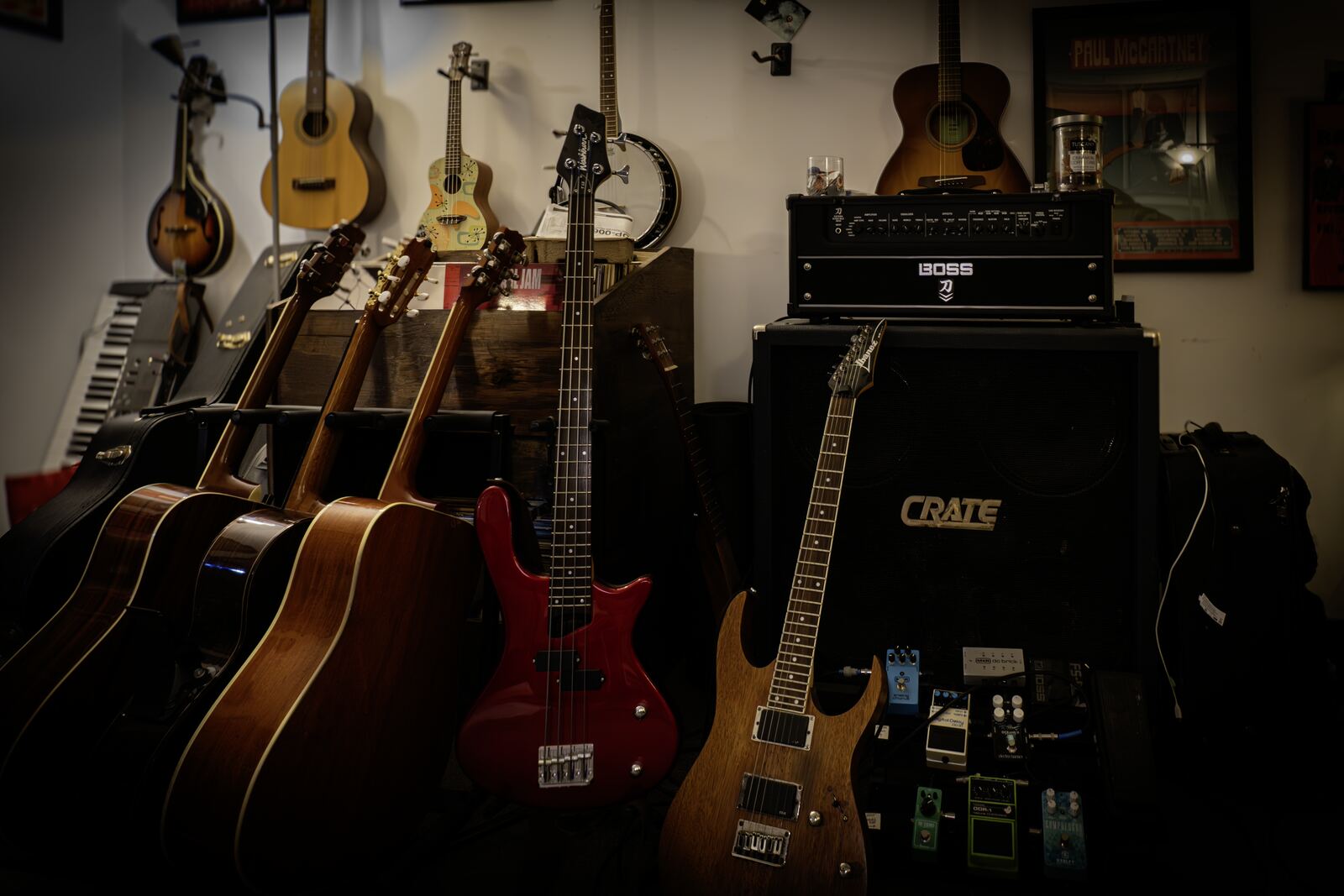
Most electric guitar shapes in use today go back to designs from the 1950s and early 1960s; the superstrat and the headless guitar followed in the 1980s. Each design fixes a neck joint, scale length, bridge and pickup set, and those parts decide more about feel and sound than the body outline. Construction types, pickup basics and scale length are in kinds of guitar.
The main designs
| Design | Neck joint | Scale | Pickups | Bridge | What the player notices |
|---|---|---|---|---|---|
| Stratocaster-style | Bolt-on | 25.5 in | Three single coils | Vintage or two-point vibrato | Comfortable body, many clean sounds |
| Telecaster-style | Bolt-on | 25.5 in | Two single coils | Fixed, through-body | Bright attack, stable tuning |
| Les Paul-style | Set | 24.75 in | Two humbuckers | Tune-o-matic, stopbar | Thick tone, easier bends, heavy |
| SG-style | Set | 24.75 in | Two humbuckers | Tune-o-matic, stopbar | Light, open upper frets |
| Offset | Bolt-on | 25.5 or 24 in | Two single coils | Floating vibrato | Mellow, gentle vibrato |
| Semi-hollow | Set | 24.75 in | Two humbuckers | Tune-o-matic, stopbar | Airy tone, resists feedback |
| Hollow archtop | Set | 24.75–25.5 in | One or two humbuckers | Floating, trapeze tailpiece | Round tone, feeds back at volume |
| Superstrat | Bolt-on or neck-through | 25.5 in | HSS or HH | Double-locking or fixed | Fast neck, 24 frets |
| V- / Explorer-style | Set or neck-through | 24.75 or 25.5 in | Two humbuckers | Fixed | Striking shape, awkward seated |
| Headless | Varies | Varies, often multiscale | Usually humbuckers | Fixed, tuners in bridge | Small, light, balanced |
The table shows the common configuration; makers vary it.
Stratocaster-style
A contoured double-cutaway body with a vibrato arm that bends the pitch of all the strings. Guitarists call it a tremolo, although tremolo strictly means a change in volume.
Telecaster-style
A flat, single-cutaway slab body. The bridge pickup sits at an angle in a metal plate and gives the sharp, bright attack the design is known for.
Les Paul-style
A single-cutaway body with a carved, arched top, usually maple on mahogany. Solid examples often weigh 9 lb or more, so many current ones have chambered or drilled bodies.
SG-style
A thin, flat body with two pointed horns, much lighter than a Les Paul-style guitar. The light body lets the headstock drop when the fretting hand lets go, a trait known as neck dive.
Offset (Jazzmaster/Jaguar-style)
The waist cuts are staggered, so the body looks skewed. The vibrato sits separately behind the bridge and suits shimmer more than deep dives. The Jazzmaster-style has wide, flat single coils that sound fuller and darker than narrow ones. Many offsets add a separate rhythm circuit with preset controls. Light strings can jump out of the saddle slots on the original bridge design, so owners often fit 11s or heavier, or a replacement bridge.
Semi-hollow (ES-335-style)
Hollow wings with f-holes sit either side of a solid wooden center block. The block gives sustain and feedback resistance close to a solid body; the wings add air and take off weight.
Hollow-body archtop
A deeper, fully hollow body. The traditional bridge floats: a wooden base held in place by string pressure alone, so changing strings one at a time keeps it from shifting. Many jazz players fit heavier flatwound strings for a round, short-sustain tone.
Superstrat
A Stratocaster-derived shape built for fast lead playing, with a deep cutaway, sculpted heel, thin neck, large frets and a flat fingerboard. Most seven- and eight-string models come from this family.
V- and Explorer-style
Angular bodies that balance well on a strap. Seated, a V-style slides off the thigh, so players rest it between the legs.
Headless
No headstock: the strings are clamped at the nut end and tuned at the bridge, which removes neck dive. Some designs need double-ball-end strings; others take standard sets.
Neck joint: bolt-on, set and neck-through
A bolt-on neck is screwed to the body, usually with four screws through a plate. It can be replaced or shimmed to correct its angle, and the heel is bulkier.
A set neck is glued in. The heel is smoother, but a neck reset is skilled repair work. Many set-neck designs also have a steeply angled headstock that can crack in a fall, so a stand or case is worth using.
On a neck-through guitar the neck wood runs the full length of the body, with wings glued on either side. There is no heel, so the top frets are easiest to reach; neck repairs are the hardest of the three.
Sustain differences between the joints are disputed; pickups, setup and strings change the sound far more.
Scale length and fingerboard radius
The 25.5 in scale feels tighter and sounds brighter; 24.75 in makes bends easier.
Fingerboard radius is the curve across the fingerboard, given as the radius of the circle it would form. A vintage 7.25 in radius is round and comfortable for chords, but wide bends can choke against higher frets when the action is low. Common modern figures are 9.5–10 in and 12 in. Superstrats use 14–16 in or flatter, for low action with wide bends. A compound radius starts rounder at the nut and flattens toward the body.
Bridges and vibratos
| Bridge | Tuning stability | String changes | Notes |
|---|---|---|---|
| Hardtail (fixed) | Highest | Quick | No vibrato |
| Tune-o-matic with stopbar | High | Quick | Intonation set per saddle; the bridge can fall off its posts if all strings come off at once |
| Vintage synchronized vibrato | Moderate | Quick | Six-screw pivot; nut friction causes most tuning drift |
| Two-point vibrato | Good | Quick | Pivots on two studs with less friction |
| Double-locking, Floyd Rose-style | Very high once set | Slow | Strings clamped at saddle and nut; fine tuners; deep dives |
| Bigsby | Moderate | Fiddly | Spring-loaded arm on a roller bar; gentle vibrato |
A floating vibrato balances string tension against springs. Tuning one string shifts the others slightly, and a broken string detunes the rest. On a double-locking bridge, a new string gauge or tuning means readjusting the springs. Many players set a vibrato flat against the body, or block it, so it behaves like a fixed bridge. Adjustment is covered in guitar setup.
Pickups and switching
A coil split switches off one coil of a humbucker, giving a brighter, thinner single-coil sound with lower output and the hum back. Active pickups need a battery and suit high-gain playing; most classic designs use passive pickups.
A three-way switch selects neck, both, or bridge. A five-way switch on a three-pickup guitar adds bridge-plus-middle and middle-plus-neck, the thin, hollow sounds of funk and clean rhythm parts. On many such guitars the middle pickup is reverse-wound with reversed magnet polarity, so those two positions also cancel hum.
Which design suits which style
These are tendencies; any of these guitars can play any style.
- Blues: Stratocaster-style, semi-hollow and Les Paul-style guitars.
- Jazz: hollow archtops and semi-hollows, mostly on the neck pickup.
- Rock: Les Paul-style, SG-style and Stratocaster-style guitars.
- Metal: superstrats and V- and Explorer-style guitars, with humbuckers or actives, often seven or eight strings.
- Indie and '90s alternative: offsets and Telecaster-style guitars.
- Country: the Telecaster-style, for its bright bridge pickup; hollow-bodies with a Bigsby in rockabilly.
Effects are a separate choice: see pedals and the signal chain.
Getting advice
Which of these suits the music you play is a good question to bring to a lesson, along with the guitar, or the listing you are looking at before you buy. The amp half of the sound has its own guide, guitar and bass amps, and guitar lessons cover every style on this site.
Questions
Should a beginner get a Strat-style or a Les Paul-style guitar?
Either works. A Stratocaster-style guitar is lighter, with more pickup sounds and a vibrato; a Les Paul-style guitar is heavier, with a fixed bridge that holds tuning well and a shorter scale that makes bends a little easier. The music the beginner wants to play matters more.
Is a floating tremolo bad for beginners?
A floating vibrato makes tuning and string changes slower, because each string's tension affects the others, and a double-locking bridge adds spring adjustment. It does not hold back learning, and it can be blocked to act as a fixed bridge.


