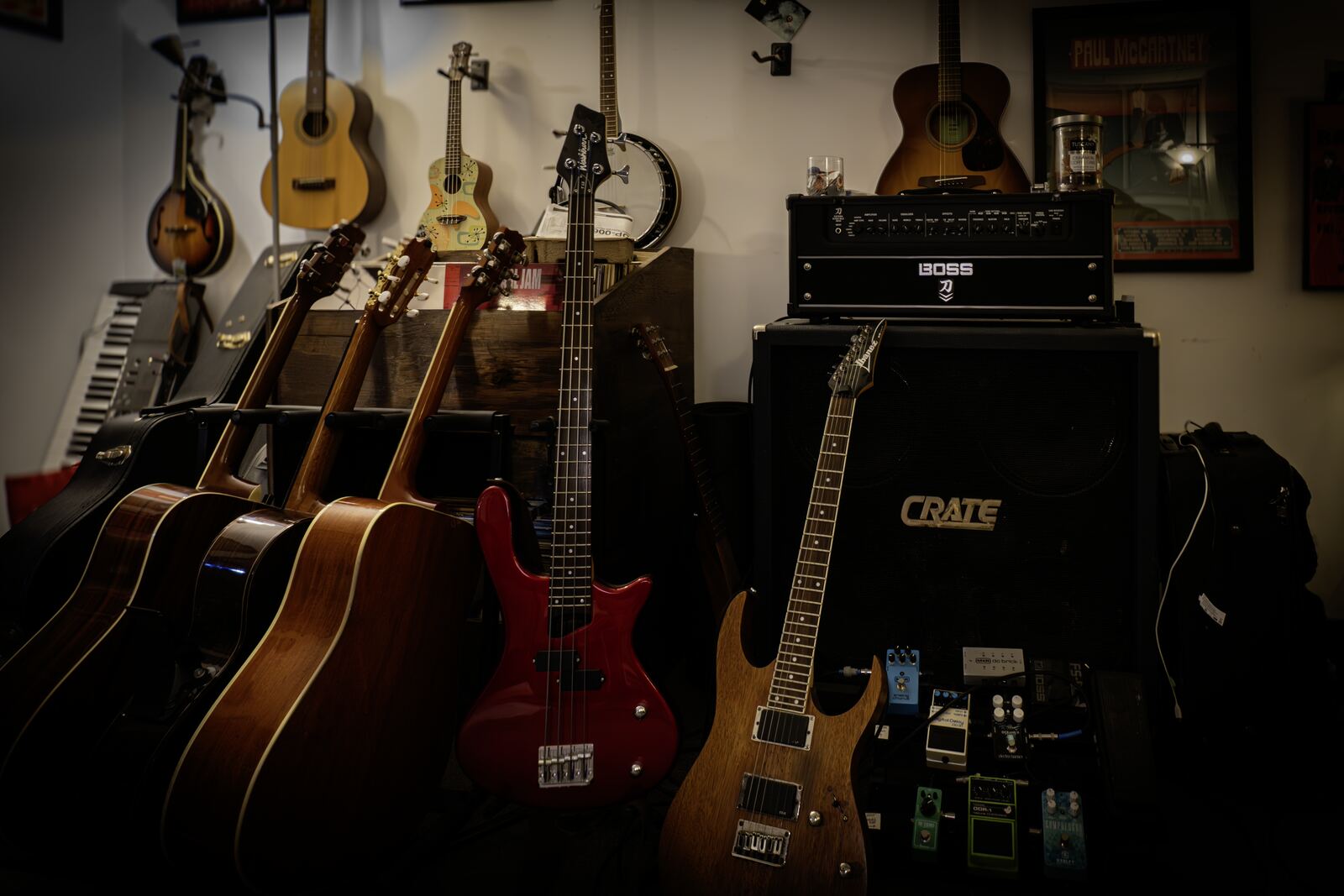
The mandolin and banjo carry the old-time and bluegrass music Virginia is known for; the ukulele is the quickest way into strumming along to songs. Each works as a first instrument, or as a second one for a guitarist.
Mandolin
The mandolin has eight strings in four pairs, called courses; the two strings of each pair are tuned to the same note and played together. The courses are tuned G-D-A-E from low to high, the same as a violin, so fiddle tunes and much violin fingering carry over.
The two main body designs are the A-style, with a symmetrical teardrop body, and the F-style, with a scroll and decorative points. A plucked mandolin note fades quickly, so players sustain long notes with tremolo picking: rapid alternate picking on one note or pair of notes.
Banjo
The five-string banjo has a short fifth string that starts at the fifth fret and is tuned to a high G. It works as a drone: a repeated note sounding against the melody. Standard tuning is open G (g-D-G-B-D), so the open strings sound a G chord.
Two right-hand styles dominate. Bluegrass three-finger style uses the thumb, index and middle fingers, usually with fingerpicks, in rolling patterns. Clawhammer strikes down with the back of a fingernail while the thumb catches the fifth string; it is the core style of old-time music.
The four-string tenor banjo has no drone string, is tuned in fifths (C-G-D-A, like a viola, or G-D-A-E an octave below a mandolin, as most Irish players tune it) and is played with a pick; it is used in Irish traditional music and early jazz. A resonator banjo has a wooden back plate that projects the sound forward, louder and brighter, and is the standard for bluegrass. An open-back banjo has no plate and a softer, mellower sound, common for clawhammer.
Ukulele
Ukuleles come in four main sizes, from smallest to largest: soprano, concert, tenor and baritone. The first three use standard G-C-E-A tuning, which is re-entrant: the G string is tuned higher than the C beside it, so the strings do not run from low to high. That gives the ukulele its bright, close-voiced strum. The baritone is tuned D-G-B-E, the same as the top four strings of a guitar.
Comparison
| Instrument | Strings | Standard tuning | Played with | Associated styles |
|---|---|---|---|---|
| Mandolin | 8, in four pairs | G-D-A-E | Pick; tremolo | Folk, bluegrass |
| Five-string banjo | 5, one of them a short drone string | g-D-G-B-D (open G) | Fingers and fingerpicks, or clawhammer | Bluegrass, old-time |
| Tenor banjo | 4 | C-G-D-A | Pick | Irish traditional, early jazz |
| Ukulele (soprano, concert, tenor) | 4, nylon-type | G-C-E-A, re-entrant | Fingers or strumming | Folk, song accompaniment |
| Baritone ukulele | 4 | D-G-B-E | Fingers or strumming | Folk, song accompaniment |
Choosing a first instrument
Of the three, the ukulele is usually the easiest start. Its four strings are soft and low in tension, the body is small, and many chords need only one or two fingers. The mandolin's steel strings in pairs need firm finger pressure, but its tuning in fifths keeps scales compact under the hand. The five-string banjo asks for right-hand coordination early, because rolls and clawhammer patterns are the foundation of its sound.
If you are choosing between them, or have an old one in the attic that needs checking, bring it to the free intro visit.
How each connects to guitar
- Ukulele: G-C-E-A has the same intervals as a guitar's top four strings, a fourth higher. Guitar chord shapes transfer with new names: a guitar G shape on those strings gives a C chord on ukulele.
- Banjo: in open G, the banjo's fourth, third and second strings (D, G and B) are tuned to the same notes as the guitar's fourth, third and second strings, so chord shapes on those strings carry over.
- Mandolin: tuned in fifths, G-D-A-E, the names of the guitar's four lowest strings in reverse order, so chord shapes do not transfer. Picking technique, theory and ear training do.
For the music these instruments are most often played in, see folk and acoustic. Sizes and body styles, from soprano to baritone ukulele, A- and F-style mandolins and the banjo family, are compared in kinds of mandolin, banjo and ukulele.
Questions
Which is easiest to learn: ukulele, mandolin or banjo?
The ukulele is usually the most approachable: soft nylon-type strings, four strings and simple chord shapes. The mandolin and banjo use steel strings and need more finger pressure and picking-hand coordination.
What do mandolin, banjo or ukulele lessons cost?
The same as every lesson at the studio: $35 for 30 minutes, once a week.


