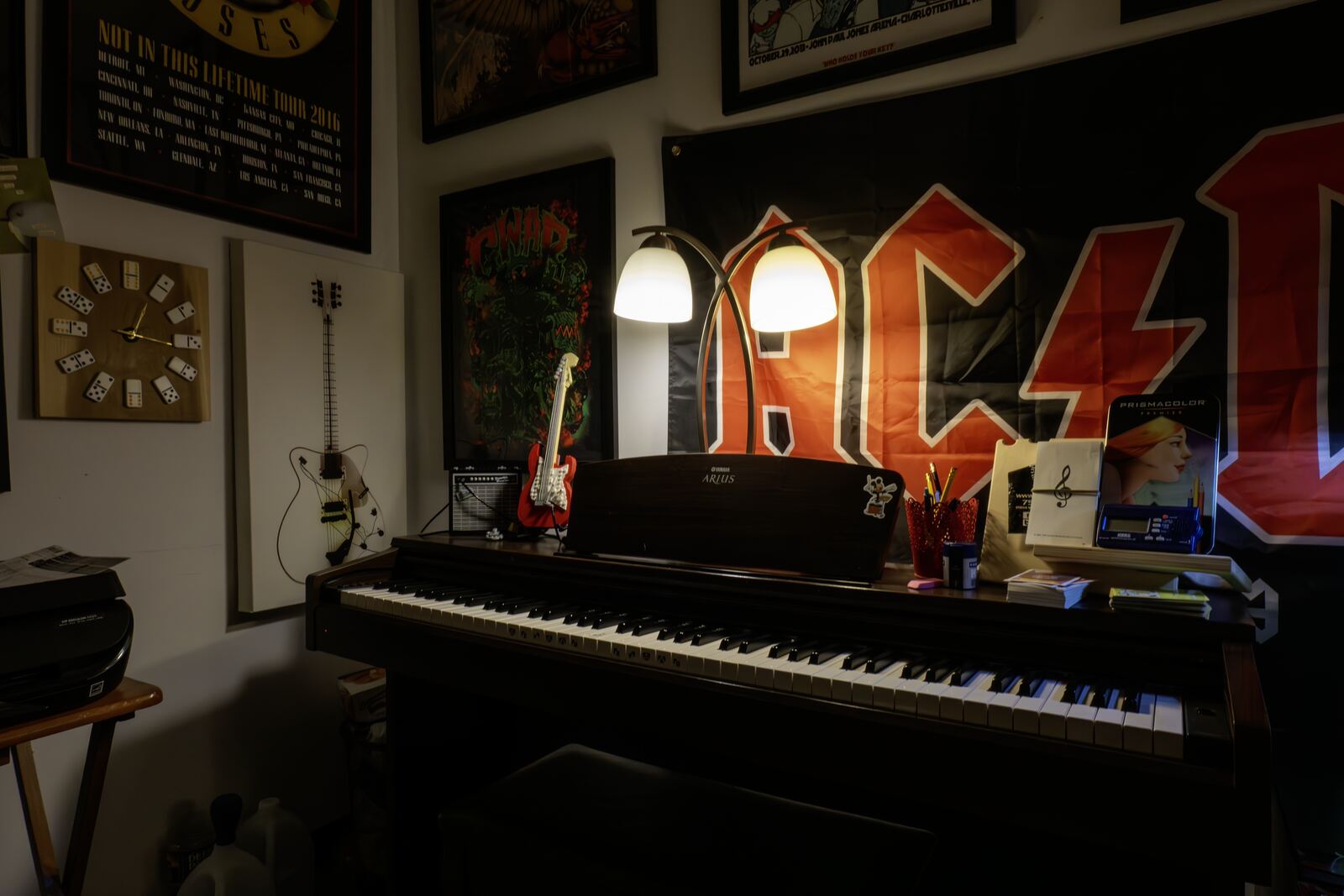
Practice between lessons happens at home, so the instrument at home shapes how a beginner's playing develops. The main differences between keyboard instruments are the number of keys, the action (how the keys feel and respond under the fingers), where the sound comes from and whether they have speakers of their own.
Acoustic pianos
A modern acoustic piano has 88 keys, from A0 to C8: just over seven octaves. Each key drives a felt-covered hammer that strikes the strings, and a soundboard amplifies the sound.
- Upright piano: the strings and frame stand vertically, so it fits against a wall. The hammers are returned by springs.
- Grand piano: the strings lie horizontally and the hammers fall back by gravity. The grand action is designed to repeat a note quickly.
Acoustic pianos need periodic tuning and are sensitive to humidity and temperature. They have no volume control; some uprights have a practice pedal that softens the sound.
Digital pianos
A digital piano plays back recorded or modeled piano sound through built-in speakers. It is built to imitate the feel of an acoustic piano rather than to offer many sounds.
- 88 keys, the full piano range.
- Weighted, hammer-action keys: a mechanism inside the keyboard gives each key resistance and a hammer-like response, as on an acoustic piano.
- Graded action: the keys are heavier in the bass and lighter in the treble, as they are on an acoustic piano.
- Touch sensitivity: the harder a key is struck, the louder and brighter the note. Also called velocity sensitivity.
- Sustain pedal: usually included, either as a single pedal or a three-pedal unit built into the stand.
- Headphone output and a volume control, so practice can happen at any hour.
Digital pianos come as furniture-style models with a fixed cabinet and pedals, or as slimmer "slab" models that sit on a separate stand. Polyphony is the number of notes the instrument can sound at once; a higher figure matters most when the sustain pedal holds many notes ringing together.
Portable keyboards
A portable keyboard usually has 61 keys (five octaves), unweighted or semi-weighted. Unweighted keys press down with almost no resistance; semi-weighted keys add some spring. Keyboards have built-in speakers, many built-in sounds and often automatic accompaniment, and many run on batteries. Most are touch sensitive, though some basic models are not, and most have a jack for a sustain pedal, which is often sold separately or supplied as a small footswitch.
Synthesizers and stage pianos
A synthesizer generates and shapes its own sound with oscillators, filters and envelopes. Key counts vary, commonly 37, 49 or 61, and most have no speakers.
A stage piano has 88 weighted keys like a digital piano but is built for performance: a sturdier case, quick sound selection and usually no built-in speakers. It needs headphones, an amplifier or a PA system to be heard.
MIDI controllers
A MIDI controller makes no sound of its own. It sends note and pedal information over USB to a computer or tablet, where software instruments produce the sound. Controllers range from 25 to 88 keys, from unweighted to fully weighted. The result depends on the software, the audio interface or computer, and the speakers or headphones. A delay between pressing a key and hearing the note, called latency, depends on that setup.
Comparison
| Instrument | Keys | Action | Sound | Built-in speakers | Best for |
|---|---|---|---|---|---|
| Acoustic upright or grand | 88 | Hammer action, the reference feel | Strings and soundboard | Not applicable | Piano study at every level |
| Digital piano | 88 | Weighted, hammer action, usually graded | Sampled or modeled piano | Yes | Piano study at home, with headphones |
| Portable keyboard | Usually 61 | Unweighted or semi-weighted | Many built-in sounds | Yes | First lessons, chords, band parts |
| Stage piano | 88 | Weighted, hammer action | Piano and other stage sounds | Usually no | Performance; home use with headphones or an amplifier |
| Synthesizer | Commonly 37–61 | Usually unweighted or semi-weighted | Sound built and shaped by the player | Usually no | Sound design and synth parts |
| MIDI controller | 25–88 | Varies | None of its own; software on a computer | No | Recording and software instruments |
What matters for a beginner
- Full-size keys. Some small keyboards have narrower keys. Full-size keys keep hand shapes and finger spacing the same on every instrument the student plays.
- Touch sensitivity. Without it, every note sounds at one volume and the student cannot practice dynamics, the changes between soft and loud.
- A real sustain pedal. A full-size pedal that stays put on the floor is easier to use than a small square footswitch that slides. A half-damper pedal, which allows partial pedaling, is not needed in the early stages.
- A stable stand. Keys that shift or bounce under the fingers make accurate playing harder. A stand that stays still when played firmly is worth more than extra sounds.
- Bench height. With the player seated, the forearms should be roughly level with the keys. An adjustable bench helps a growing child, and a footrest helps when the feet do not reach the floor.
- Headphones. Closed-back headphones allow practice without disturbing the household, which makes short, frequent sessions easier to fit in. See how to practice.
When 61 keys is enough, and when 88 is needed
A 61-key keyboard covers early beginner material, chords, accompaniment, most keyboard parts in band styles and synthesizer work. It suits a student who is starting with songs and chords, or a young child testing interest in the instrument.
Classical and traditional piano study needs the full range and weighted keys. Much of the piano repertoire uses the outer octaves, and its dynamics and pedaling assume an action that responds like an acoustic piano. A student moving toward that repertoire is better served by 88 weighted keys from the start, since the finger strength and control built on unweighted keys do not fully transfer.
Getting advice
If you are about to buy, ask first: which instrument suits the goal is one of the things the free intro visit is for. Lessons are described on the piano and keyboard page, and synths have their own guide, synthesizers explained.
Questions
Is a keyboard good enough for beginner piano lessons?
A 61-key keyboard with full-size, touch-sensitive keys and a sustain pedal can work in the early stages, especially for songs and chords. For classical or traditional piano study, a digital piano with 88 weighted, hammer-action keys is the usual recommendation.
Does a beginner need a three-pedal digital piano?
No. The sustain pedal is the one a beginner uses most. A single full-size sustain pedal is enough for the early stages; the other pedals and half-damper control matter later.
Can a MIDI controller be used for piano lessons?
A MIDI controller makes no sound by itself, so it needs a computer or tablet, software and speakers or headphones. With 88 weighted keys and a sustain pedal it can serve for practice, though a digital piano is simpler to switch on and play.


