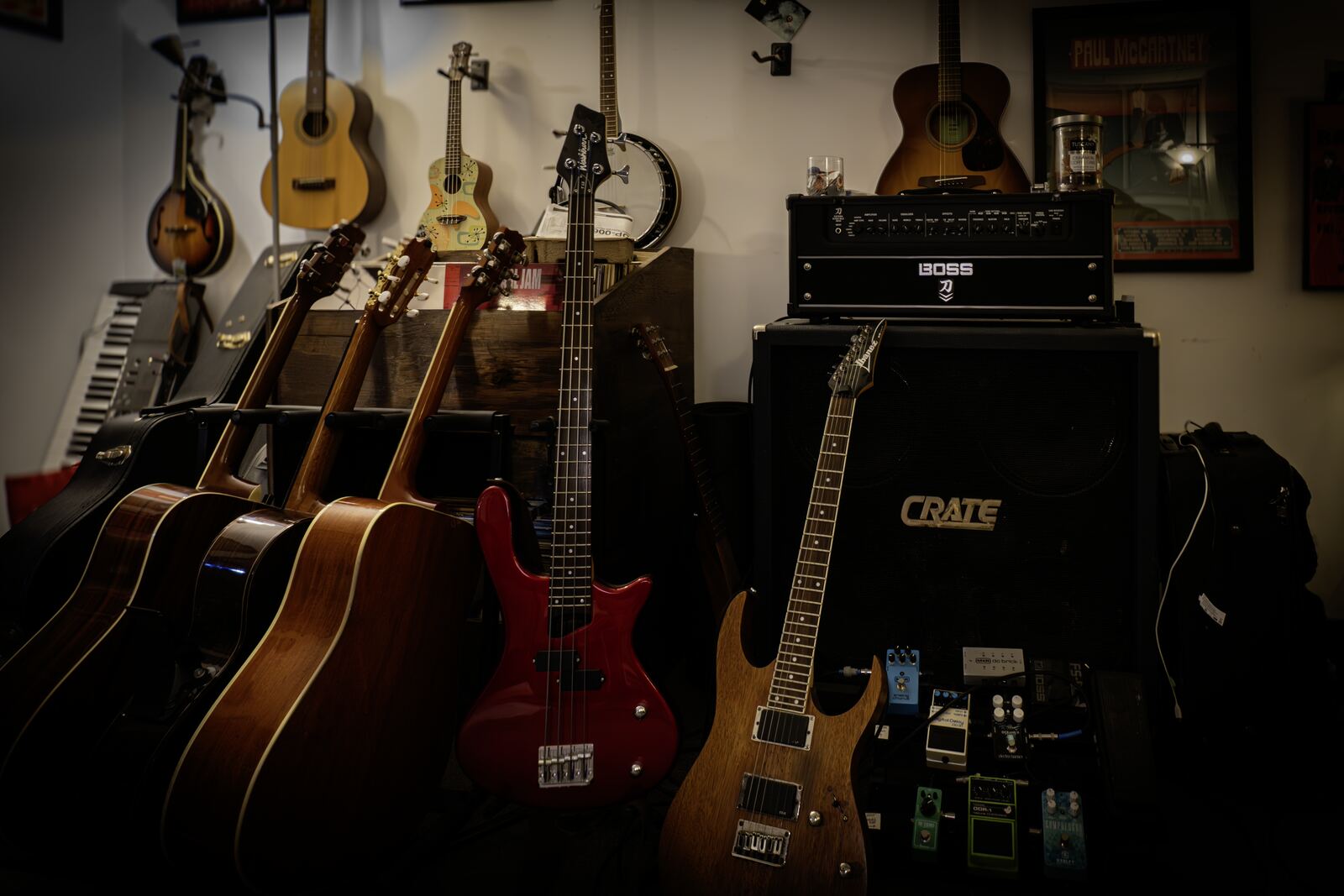
Guitars differ in four ways that matter to a player: the strings, the body, the scale length and the electronics. The sections below take the main families in turn, with the terms a shop or a spec sheet will use. Electric designs are covered in more depth in electric guitar types, and twelve-string, resonator, flamenco and other acoustic families in acoustic guitar types.
Nylon-string guitars
The classical guitar uses nylon treble strings and bass strings wound over a nylon core. Its neck is wide and flat, typically about 50–52 mm at the nut, and joins the body at the 12th fret. Nylon runs at lower tension than steel, so it is gentler on the fingertips, and the tone is warm and rounded.
It is the instrument of the classical repertoire, from Sor and Giuliani to Tárrega and Villa-Lobos, and is also used in flamenco, bossa nova and folk.
There are also crossover nylon-string guitars with slimmer necks, made for players coming from steel strings; acoustic guitar types describes them.
Steel-string acoustic guitars
Steel strings, at much higher tension, are louder and brighter and ring longer, and the neck is narrower than a classical's. Body size and woods shape the rest of the sound, as acoustic guitars, tonewoods and strings explains.
Electric guitar bodies
An electric guitar's sound comes mainly from its pickups and amplifier, but the body still affects sustain, resonance and how the instrument behaves at volume.
| Body type | Construction | Sound and behavior | Typical uses |
|---|---|---|---|
| Solid body | Solid wood, sometimes chambered to reduce weight | Long sustain; resists feedback at high volume | Rock, metal, blues, pop, country |
| Semi-hollow | Hollow wings around a solid center block | Some acoustic air and warmth; more feedback-resistant than a full hollow body | Blues, jazz, rock |
| Hollow-body archtop | Fully hollow body with an arched top, usually with f-holes | Round, woody tone with some acoustic volume; prone to feedback at high gain | Jazz, swing, rockabilly |
Pickups
A pickup is a magnet wrapped in a coil of fine wire. The vibrating steel string disturbs the magnetic field and induces a small electrical signal, and the design of the coil sets most of the pickup's character.
| Pickup | Design | Character | Trade-off |
|---|---|---|---|
| Single-coil | One narrow coil | Bright, clear, sharp attack | Picks up mains hum |
| Humbucker | Two coils with opposite winding and magnetic polarity | Thicker, warmer, higher output; cancels hum | Less treble detail than a single-coil |
| P-90 | One wide, flat coil | Fuller midrange and more grit than a narrow single-coil | Hums like other single-coils |
| Active | Pickups paired with a battery-powered preamp | Quiet, consistent, high output; stays defined under heavy distortion | Needs a battery; responds less to changes in touch |
Many guitars combine types, for example a humbucker at the bridge and single-coils elsewhere, with a selector switch to choose among them. Whatever the type, a pickup near the neck sounds warmer and one near the bridge sounds brighter and more cutting.
Scale length
Scale length is the vibrating length of the open string, from the nut to the saddle. At the same pitch and string gauge, a longer scale needs more tension: the strings feel stiffer, bends take more effort, and the tone is usually tighter and brighter. A shorter scale feels looser, makes bends easier and places the frets closer together.
| Scale | Approximate length | Where it appears |
|---|---|---|
| Short | 22.5–24 in (572–610 mm) | Travel guitars, children's guitars, some electrics |
| Medium | about 24.75 in (629 mm) | Many electric and acoustic guitars |
| Long | about 25.5 in (648 mm) | Many electric and acoustic guitars; many seven-strings |
| Classical | about 650 mm (25.6 in) | Full-size nylon-string guitars |
| Extended | 26.5–30 in (673–762 mm) | Eight-strings, baritones |
Extended-range guitars
A seven-string guitar adds a low string, usually tuned to B, below the standard six (B–E–A–D–G–B–E). An eight-string adds another below that, usually F♯. The extra range allows lower riffs and wider chord voicings. Both are common in modern metal; seven-strings also appear in jazz chord-melody playing and, with nylon strings, in Brazilian choro.
Multiscale (fanned-fret) guitars have angled frets that give the bass strings a longer scale than the treble strings. The low strings keep their tension and clarity at low tunings while the high strings stay easy to bend. The design is most common on seven- and eight-strings and some basses.
Baritone guitars
A baritone guitar is a six-string guitar with a longer scale, typically 27–30 in, built to be tuned lower than standard. The usual tunings are a fourth below standard (B to B) or a fifth below (A to A), and other low tunings are used as well. The longer scale keeps the low strings taut enough to stay clear and in tune, where a standard guitar tuned that low would feel slack and buzz.
Baritones are used in heavy music for low riffs, in surf and country twang for deep melody lines with plenty of reverb, and in film and ambient music for dark, wide textures. Chord shapes are the same as on a standard guitar; everything simply sounds lower.
| Seven-string | Baritone | |
|---|---|---|
| Strings | Seven | Six |
| Tuning | Standard six plus one low string | All six strings lowered, often by a fourth or a fifth |
| Scale | Usually standard to slightly long | Long, typically 27–30 in |
| Chord shapes | Standard shapes on the top six, new shapes with the seventh | Standard shapes, sounding lower |
| Range | Keeps the standard top end | Gives up the top of the standard range |
Other kinds of guitar
- Twelve-string. Six pairs of strings, called courses. The lower four courses pair each string with one an octave higher; the top two pair strings at the same pitch. The result is a shimmering, chorus-like sound used for strummed folk and rock accompaniment.
- Resonator. Metal cones inside the body work as a mechanical amplifier, for a loud, metallic, cutting tone: the sound of slide blues and of bluegrass lap-style playing. Acoustic guitar types has the details.
- Travel and short-scale guitars. Smaller bodies, shorter scales or both, for travel and smaller hands. They are quieter and have less bass than full-size guitars.
Getting advice
Bill advises students on which kind of guitar suits the music they want to play, and on its setup and strings, including baritone guitars for low-tuned music. That advice starts at the free intro visit and continues in guitar lessons.
Questions
Should I get a seven-string or a baritone guitar?
A seven-string keeps standard tuning on six strings and adds one low string, so it extends the range downward without losing the top. A baritone lowers all six strings, keeping familiar chord shapes but moving the whole instrument down. The first suits a player who wants standard tuning plus extra low notes; the second suits a player who wants everything lower.
What is the difference between single-coil and humbucker pickups?
A single-coil pickup sounds bright and clear but picks up electrical hum. A humbucker pairs two coils with opposite winding and polarity to cancel that hum, giving a thicker, warmer, higher-output sound.


