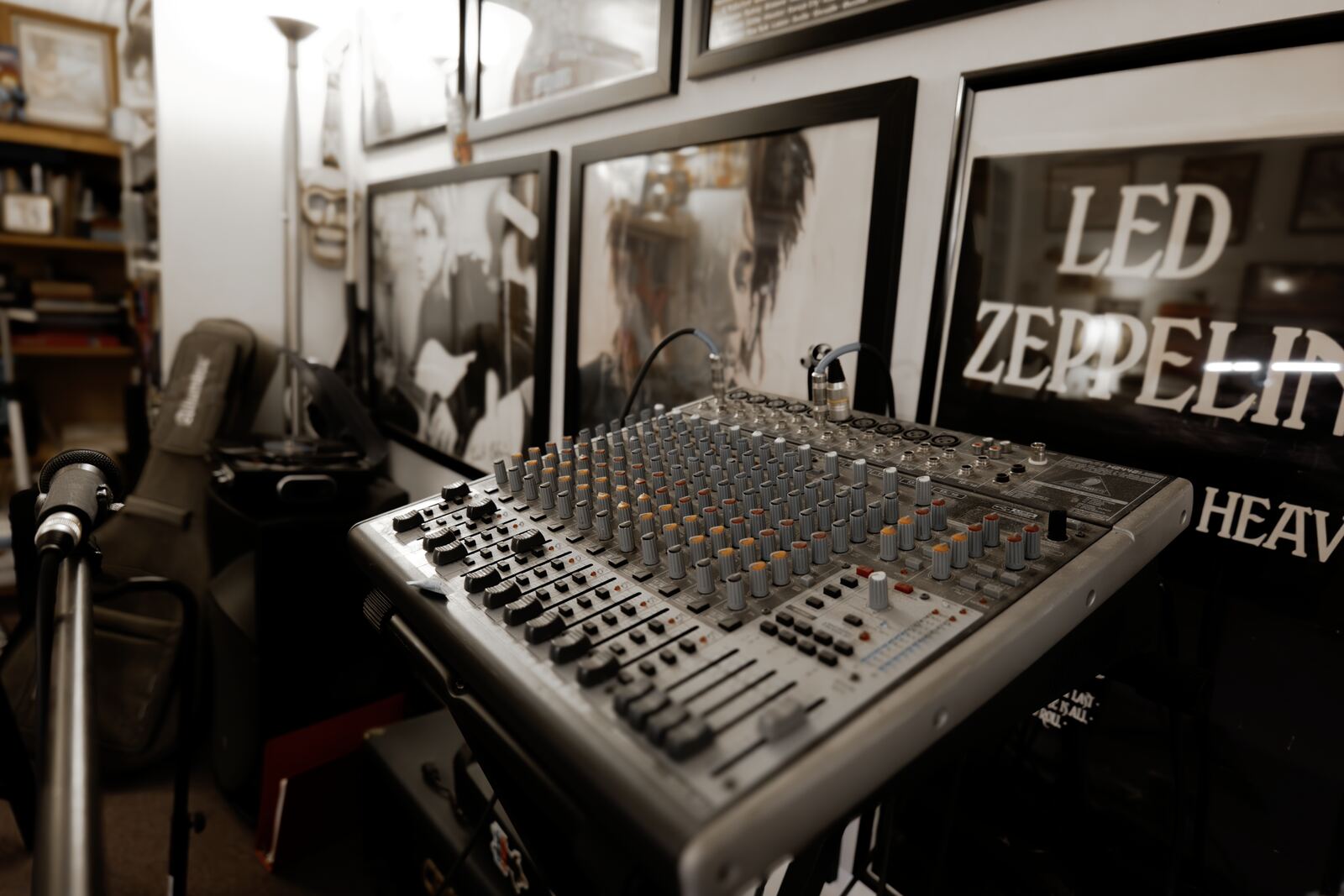
A synthesizer generates its sound electronically, and the controls on its panel reshape that sound as it plays. Weighted keys and 88-key instruments are covered in the guide to digital pianos and keyboards.
The signal path
Most synths follow the same classic layout, and use the same control names: oscillator, filter, amplifier. Envelopes and LFOs move the settings of those three over time.
The oscillator produces a repeating waveform at the pitch of the key played, and the waveform control sets its raw tone. A sine is pure, with no overtones. A square has only odd harmonics and sounds hollow, close to a clarinet; narrowed, it becomes a thinner pulse wave. A sawtooth has every harmonic and sounds bright and buzzy, the usual starting point for strings, brass and leads.
The filter removes part of the frequency range. A low-pass filter, the most common kind, cuts the highs above the cutoff frequency: turning cutoff down darkens the sound, turning it up brightens it. Resonance (also labelled emphasis or Q) boosts a narrow band at the cutoff for a vocal, peaky edge; on many filters a high setting makes the filter whistle at its own pitch. A 24 dB-per-octave filter cuts more steeply than a 12 dB one.
The amplifier sets the volume of each note, and an envelope gives that volume its shape.
Envelopes, ADSR and LFOs
An envelope is a contour that starts when a key goes down and ends after it comes up:
- Attack: the time from key press to full level. Short for plucks, long for swelling pads.
- Decay: the time taken to fall from that peak to the sustain level.
- Sustain: the level held while the key stays down. It is a level, not a time.
- Release: the time the sound takes to fade after the key is let go.
A piano-like envelope has a fast attack, a long decay and no sustain. Most synths have a second envelope for the filter, with an amount control that sets how far it sweeps the cutoff. A short filter-envelope decay makes a bass note sound plucked.
A low-frequency oscillator (LFO) cycles too slowly to be heard as a pitch, typically from a fraction of a cycle per second up to around 20 cycles; the range varies by maker. It moves another setting instead: on pitch it gives vibrato, on the amplifier tremolo, on the cutoff a rhythmic sweep.
The small synth below has one oscillator, a low-pass filter and an amplifier envelope, which is enough to hear everything described so far.
Try it: a one-oscillator synth
Hold a key (or the letter shown on it) to play. Try a slow attack with a long release, then a short decay with no sustain, and listen to how the envelope changes the same note.
Synthesis methods
| Method | How it makes sound | What it sounds like, and typical uses |
|---|---|---|
| Subtractive | Starts from bright waveforms and removes frequencies with a filter | Classic synth bass, leads, brass and pads; the easiest method to learn |
| FM (frequency modulation) | One oscillator changes the frequency of another at audio rate, creating new overtones | Bells, electric pianos, metallic tones and punchy basses; harder to program by ear |
| Wavetable | The oscillator sweeps through a table of different single-cycle waveforms | Tones that shift as the position moves; modern basses, pads and leads |
| Additive | Adds together many sine waves, each with its own level | Control of every harmonic; organ drawbars work on the same idea |
| Sample-based | Plays recordings of real instruments, often through a filter and envelopes | Realistic pianos, strings, choirs and drums |
| Granular | Splits a recording into tiny grains and replays them layered, stretched or reordered | Clouds, textures and evolving ambient pads |
Analog, digital and virtual analog
An analog synth makes its sound with electronic circuits. Small differences between voices and slight pitch drift are part of its character; some vintage instruments need warming up before they hold tune. A digital synth calculates its sound with a processor, which makes FM, wavetable, sample-based and granular synthesis practical. Virtual analog is digital synthesis modelled on the analog subtractive design.
Monophonic, paraphonic and polyphonic
A voice is one complete set of oscillators, filter, amplifier and envelopes that sounds one note. A monophonic synth has one voice: it plays bass lines and leads but no chords. A paraphonic synth sounds several pitches through one shared filter, often with one shared envelope, so held notes are shaped together. A polyphonic synth gives each voice its own filter and envelopes, so chords behave as a keyboard player expects.
The voice count is the synth's polyphony: commonly 4 to 16 on analog polysynths, often many more on digital ones. Past that count, the synth cuts a note off.
Keyboard, module, modular or software
| Format | What it is | Played from | Presets | Suits |
|---|---|---|---|---|
| Keyboard synth | Synth and keys in one instrument | Its own keys | Usually | A first synth that works on its own |
| Desktop module | The synth engine in a box with no keys | A MIDI keyboard or sequencer | Usually | Adding sounds to a keyboard already owned |
| Modular (Eurorack) | Separate modules in a case, wired with patch cables | A sequencer, or a keyboard through a MIDI-to-CV converter | No; the patch is the sound | Sound design, once the signal path is familiar |
| Software synth | A program on a computer or tablet, standalone or as a plug-in | A MIDI controller over USB | Usually many | Recording, and many instruments on one machine |
Eurorack, the most common modular format, passes control voltages (CV) between modules rather than MIDI.
Arpeggiator and step sequencer
An arpeggiator plays the notes of a held chord one after another, up, down or at random, over a set octave range; a latch switch keeps it running after the hands leave the keys. A step sequencer stores a repeating pattern, commonly 16 steps, each a note or a rest, and loops it, leaving the hands free for the knobs.
MIDI and USB
MIDI carries performance instructions, not sound: which note, how hard it was struck (velocity), when it was released, and movements of wheels, pedals and knobs. The classic connector is a 5-pin DIN socket; many compact synths use 3.5 mm jacks with an adapter, and two wirings exist for those, so the adapter has to match. Over USB, most current synths connect to a computer without a driver. MIDI clock keeps an arpeggiator or sequencer in time with other gear.
What to check before buying a first synth
- Keys: 25 or 37 keys suit bass and lead lines; 49 or 61 leave room for two hands. Mini keys are narrower than standard ones, so a piano player's hand spacing carries over only to full-size keys. Velocity-sensitive keys respond to how hard each note is played.
- Polyphony: monophonic for bass and leads, polyphonic for chords.
- Knobs or menus: one knob per function lays out the signal path and is the clearest way to learn it. A menu-driven synth full of presets gives more sounds sooner but hides how they are made.
- Speakers: most synths have none, so plan for headphones, a keyboard amplifier or powered monitors.
- Outputs and headphone jack: mono or stereo line outputs, usually 1/4-inch jacks, and a headphone jack; some compact units share one 3.5 mm jack between the two.
- Connections and power: MIDI in and out, USB, and a mains adapter, USB power or batteries.
Getting advice
Bill teaches synthesizer as part of piano and keyboard lessons, alongside reading, theory and ear training. When a song the student brings has a synth part, Bill writes it out and plays the other part along. Advice on choosing an instrument starts at the free intro visit.
Questions
Should a beginner buy an analog or a digital synth?
Both teach the same controls when they follow the oscillator, filter and amplifier layout. Digital synths usually offer more voices; an analog synth is chosen for its sound, which is a matter of taste.
Is a synthesizer the same as a keyboard for learning piano?
No. A synth with 49 or 61 full-size, velocity-sensitive keys works for songs, chords and band parts. Classical and traditional piano study needs 88 weighted keys, which most synthesizers do not have.


