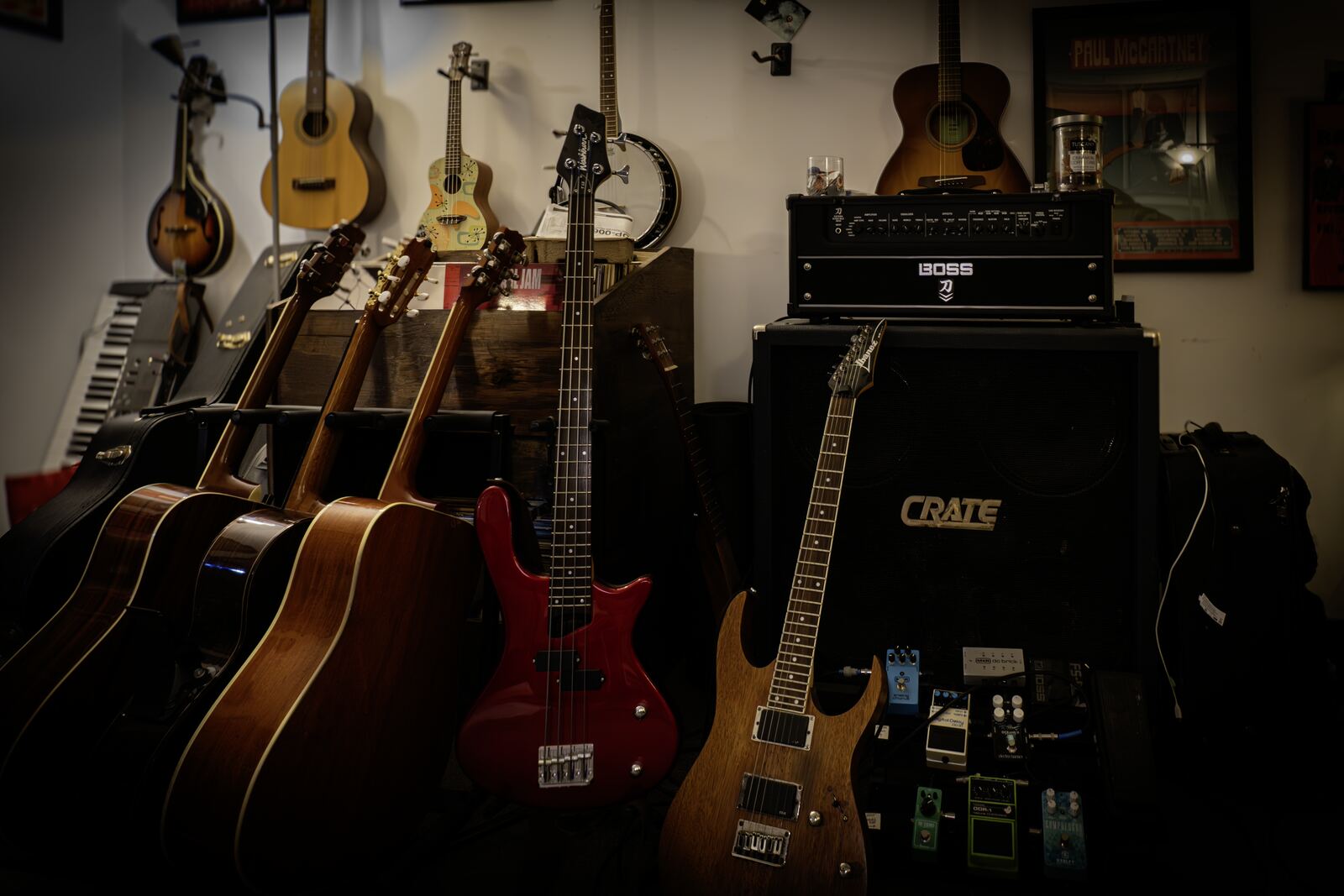
The format
- One to one: the student and Bill, nobody else.
- Once a week for 30 minutes: $35, the same for every instrument and every age.
- At the studio, on the student's own instrument.
Nobody pays for a first lesson to find out whether the studio suits them: a free intro visit comes first.
What a lesson covers
- Reading: standard notation, and tab (tablature: a diagram of the strings with the fret number for each note).
- Theory and ear training: how scales, chords and keys fit together, and hearing them without looking.
- Technique: posture, the picking or fretting hand, fingering, timing.
- Songs the student picks.
A student aiming at a jazz standard spends more time on chords and theory; one who wants to play along with a favourite record spends more time on the record. The mix follows the goal.
Learning a song you chose
Bring the song. Bill writes it out for you in notation or tab, starting with a version that keeps only what the song can't do without: the main riff, the chord changes or the tune. Fills, voicings and the trickier passages are added as your playing catches up. Each part is learned in turn, and Bill plays the other part with you, so from the first week it sounds like the song rather than an exercise.
Between lessons
How much there is to do at home depends on what you are aiming for and by when. A student with a gig coming up will have more to work on than one who plays for fun, and for some there is nothing formal at all. When there is something, it might be a chart or tab sheet, one passage to bring up to tempo, or a phone video of Bill playing the part so you can hear how it should go.
The guide on how to practice has a plan for a 15- or 30-minute session.
Beyond lessons
Lessons can lead to a stage. Bill gets students ready for open mics and for playing with a band, and the practical side of playing live is something he knows from his own gigs as a bassist. Students can also record at the studio.
Where to start
Three quick questions point you to the pages that matter for you.
Where to go next
- By instrument: piano and keyboards, guitar, bass, mandolin, banjo and ukulele, songwriting, music theory and ear training.
- Styles, from classical to metal.
- Guides to instruments, amps, strings and practice.
- Lessons for kids and adults.
Questions
Can I switch instruments later?
Yes. Bill teaches every instrument on this site, so a student who starts on guitar and later wants piano or bass keeps the same teacher.
Can lessons prepare me for a performance or a recording?
Yes. Open mics, a first band, or a recording made at the studio: all of them can be the goal lessons work toward.


