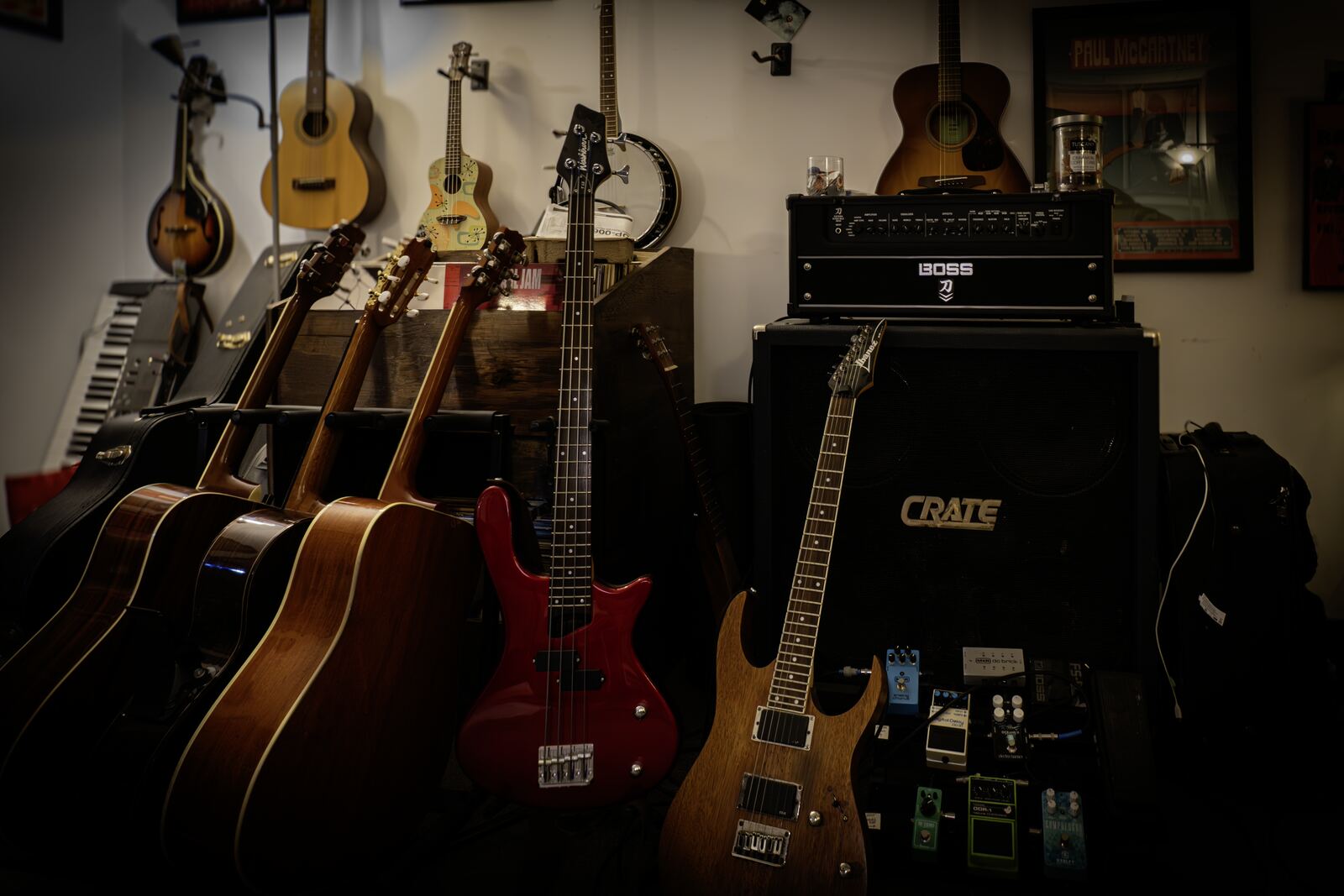
A setup is the adjustment of a guitar for playability: string height, neck curvature, nut slots and intonation, matched to the strings fitted and the player's touch. A guitar that is hard to play, buzzes or goes out of tune up the neck usually has a setup problem, not a quality problem.
Action: string height
Action is the height of the strings above the frets. It is measured at the 12th fret, from the top of the fret to the underside of the low E and high E strings, with a steel rule or an action gauge.
| Guitar | Low E at the 12th fret | High E at the 12th fret |
|---|---|---|
| Electric | about 1.6–2.0 mm | about 1.2–1.6 mm |
| Steel-string acoustic | about 2.0–2.8 mm | about 1.6–2.0 mm |
| Classical (nylon) | about 3.0–4.0 mm | about 2.5–3.2 mm |
These are common starting points; a light touch allows lower action, and slide players need more. High action makes every note harder to press and pulls fretted notes sharp. Action set too low causes buzzing.
Electric guitars set action at adjustable bridge saddles. An acoustic saddle is lowered by sanding its base and raised with a shim or a new saddle.
Relief and the truss rod
Relief is the slight forward bow of the neck under string tension, which gives the strings room to vibrate. To check it, fret the low E at the first fret and where the neck meets the body, then look at the gap over a fret around the 7th or 8th. A typical gap is about a quarter of a millimeter (roughly .010 in).
The truss rod is a steel rod inside the neck that counteracts string tension and sets the relief. Too little relief makes the low frets buzz; too much raises the action in the middle of the neck.
Truss rod adjustment is a job for a qualified technician. It is made in small fractions of a turn, and the neck needs time to settle afterwards. A rod that feels stiff or stops turning must never be forced: forcing it can strip the adjusting nut or break the rod. The rod corrects neck curvature only, not action. Many traditional classical guitars have no truss rod.
The nut: why the first frets hurt
The nut is the slotted piece at the top of the neck, and its slots set the string height over the first fret. Factory nuts are often cut high. That makes the first three frets, where beginners play most of their chords, harder to press than the rest of the neck, and pulls chords near the nut sharp.
To check, fret each string at the 3rd fret and look at the gap over the 1st fret. It should be very small. A large gap means a high slot; no gap, or buzz on open strings only, means a slot too low or worn. A slot cut too deep means refilling or replacing the nut, so this is technician work.
Intonation and saddle position
Intonation is whether the guitar stays in tune up the neck. With a tuner, compare the harmonic at the 12th fret with the fretted note there. If the fretted note is sharp, the saddle moves back, away from the neck; if flat, it moves forward.
Most electric guitars have an adjustable saddle for each string. An acoustic saddle is one piece, corrected by reshaping where each string crosses it. Intonation is set last, because action and relief both change it.
Symptoms, causes and fixes
Some buzz is normal when a guitar is played hard. Where a persistent buzz sits on the neck usually reveals its cause.
| Symptom | Likely cause | Usual fix |
|---|---|---|
| Hard to press everywhere | High action; heavy strings | Lower the saddle; lighter gauge |
| First frets hard to press, chords sharp near the nut | Nut slots cut high | Lower the nut slots (technician) |
| Buzz on open strings only | Nut slot too low or worn | Shim, refill or replace the nut (technician) |
| Buzz on the first few frets | Too little relief | Truss rod adjustment (qualified person) |
| Buzz high up the neck only | Action too low; raised frets near the body | Raise the action; level or reseat frets |
| Buzz on one or two notes | One high or worn fret | Fret level or spot repair |
| In tune open, sharp higher up | Intonation | Saddle position or compensation |
| Action higher in summer, buzz in winter | Humidity changing the wood | Control humidity; seasonal adjustment |
| Strings feel floppy, notes waver | Gauge too light for the tuning | Heavier gauge, then recheck the setup |
String gauge and feel
Gauge is string diameter, and a set is named by its high E in thousandths of an inch: a set of 10s starts at .010. At the same pitch and scale length, a heavier string needs more tension. It feels stiffer, bends less easily and pulls harder on the neck, in return for more volume and a fuller sound.
Common sets run from about .009–.042 to .010–.046 on electric guitars and .011–.052 to .012–.053 on steel-string acoustics. A large change in gauge changes the relief, and heavier strings may bind in nut slots cut for lighter ones. Lighter strings are the simplest way to ease a steel-string guitar while the fingertips toughen. Lower tunings need heavier strings, as the guide to alternate tunings explains.
Humidity and the seasons
Wood takes on and gives off moisture. In humid summer weather an acoustic top swells and can bulge behind the bridge, raising the action. In a heated house in winter the top sinks, the action drops and buzzing starts, and the fingerboard can shrink enough for fret ends to protrude along the edge of the neck.
Solid-wood acoustics are the most sensitive, and prolonged dry air can crack the top or back. Roughly 45–55 percent relative humidity is the commonly recommended range; in the heating season, a hygrometer and a soundhole or case humidifier keep an acoustic within it.
When a setup is worth it on an inexpensive guitar
A setup costs the same labor whatever the guitar cost, so first check that the guitar can respond to one: a straight, untwisted neck, a truss rod that turns, saddle height left to lower, and reasonably level frets. A twisted neck, a lifting bridge, a saddle already sanded almost flush, or a neck angle too far off to bring the action down are signs a setup will not help much.
On a sound guitar, a setup is often the most effective improvement available, because high factory action is the most common reason a new guitar feels hard to play.
Getting advice
Because you bring your own guitar or bass to lessons, Bill gets to see the instrument you actually practise on, and can tell you whether its setup or strings are holding you back. Truss rod, nut and fret work is for a qualified guitar technician. See guitar lessons and bass lessons.
Questions
Why is my guitar so hard to play?
The usual cause is high action, often with high nut slots that make the first frets hard to press; heavy strings add to it. A setup that lowers the saddle and nut slots, and a lighter string gauge, usually fix it.


