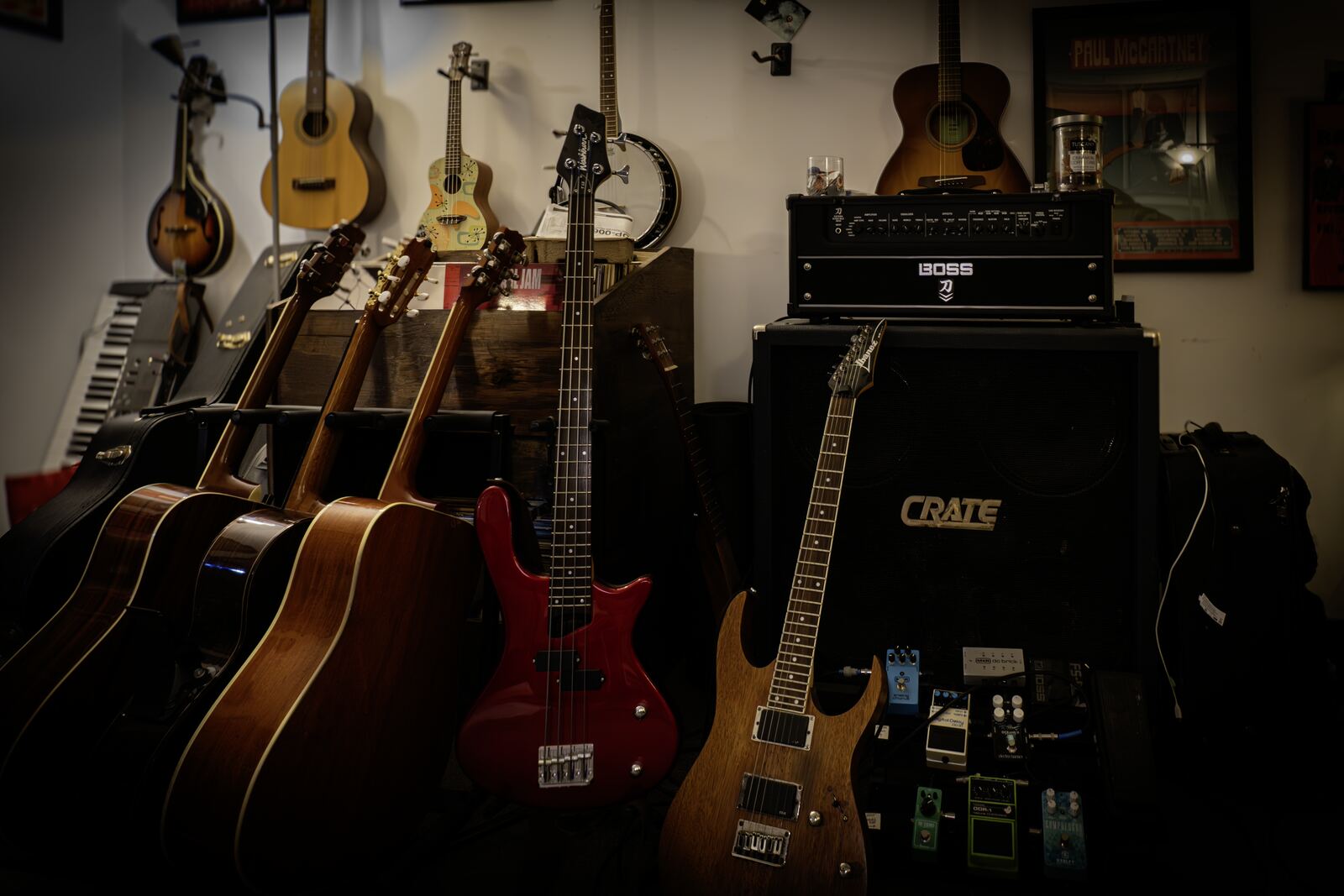
Rock and metal are taught on electric guitar and bass. The common ground is rhythm playing: riffs (short repeated figures that carry a song) and rhythm parts, picked accurately and muted cleanly, matter more than speed or solos.
Rock foundations
- Power chords: the root and fifth of a chord, often with the octave, written E5 or A5. Under distortion they stay clear where full major and minor chords turn muddy.
- Palm muting: the edge of the picking hand rests on the strings near the bridge, giving a tight, percussive chug.
- Alternate picking: strict down-up picking for even timing on faster lines.
- Down-picking: all downstrokes on eighth-note rhythm parts, for a heavier, more consistent attack.
- Lead basics: the minor pentatonic scale, bends, vibrato and slides.
Metal: precision at speed
Metal asks for the same rhythm skills at higher tempos and with more gain (the amount of distortion). Two picking patterns define much of it: the gallop, an eighth note followed by two sixteenths (or the reverse) repeated as a driving rhythm, and tremolo picking, one note picked as fast and evenly as possible.
Lower tunings give the music its weight:
| Tuning or instrument | Strings, low to high | What it does |
|---|---|---|
| Standard | E A D G B E | the reference tuning for most rock |
| Drop D | D A D G B E | one-finger power chords on the lowest three strings, and a low D |
| Drop C | C G C F A D | the same one-finger shapes, a whole step lower |
| Seven-string guitar | B E A D G B E | an extra low string, with standard tuning intact above it |
| Baritone | commonly B E A D F♯ B | a longer neck keeps low-tuned strings at full tension |
A noise gate cuts the signal when the strings are not being played, removing the hum and hiss that high gain amplifies. The pedals and signal chain guide covers it; seven-string and baritone guitars are in the kinds of guitar guide.
Bass in heavy music
The bass locks with the kick drum and anchors or doubles the guitar riffs, often played with a pick for a sharper attack. Low tunings carry over to bass, through drop tunings or a five-string bass with an added low B. See bass lessons.
Grunge and punk
The looser, fuzzier side of heavy guitar, with drop D, loud-quiet dynamics and fast downpicked punk rhythm, has its own page: grunge, punk and '90s alternative.
Tone and gain staging
Gain staging means setting the level and distortion at each point of the chain (guitar, pedals, amp) so the sound stays clear. Too much gain blurs chords and amplifies noise; on a recording, a heavy tone usually needs less gain than it seems to in the room.
How lessons approach rock and metal
Bring a song and Bill writes it out starting from the main riff; the fills, lead lines and solo come in as the rhythm part tightens. He plays the other part with you, so the riff is locked against a second line from the first week, the way it will be in a band. When students want to play out, he prepares them for open mics and band rehearsals, and students can record at the studio.
Questions
Should I learn rock on electric or acoustic guitar?
An electric guitar is the direct route. Palm muting, bends and working with distortion depend on the electric guitar and amp, and lighter electric strings make bends easier.
What gear do I need to start metal guitar?
An electric guitar, an amplifier or amp modeler with enough gain, a tuner and picks. A noise gate becomes useful as gain rises, and a seven-string or baritone guitar only when the music calls for lower tunings.


