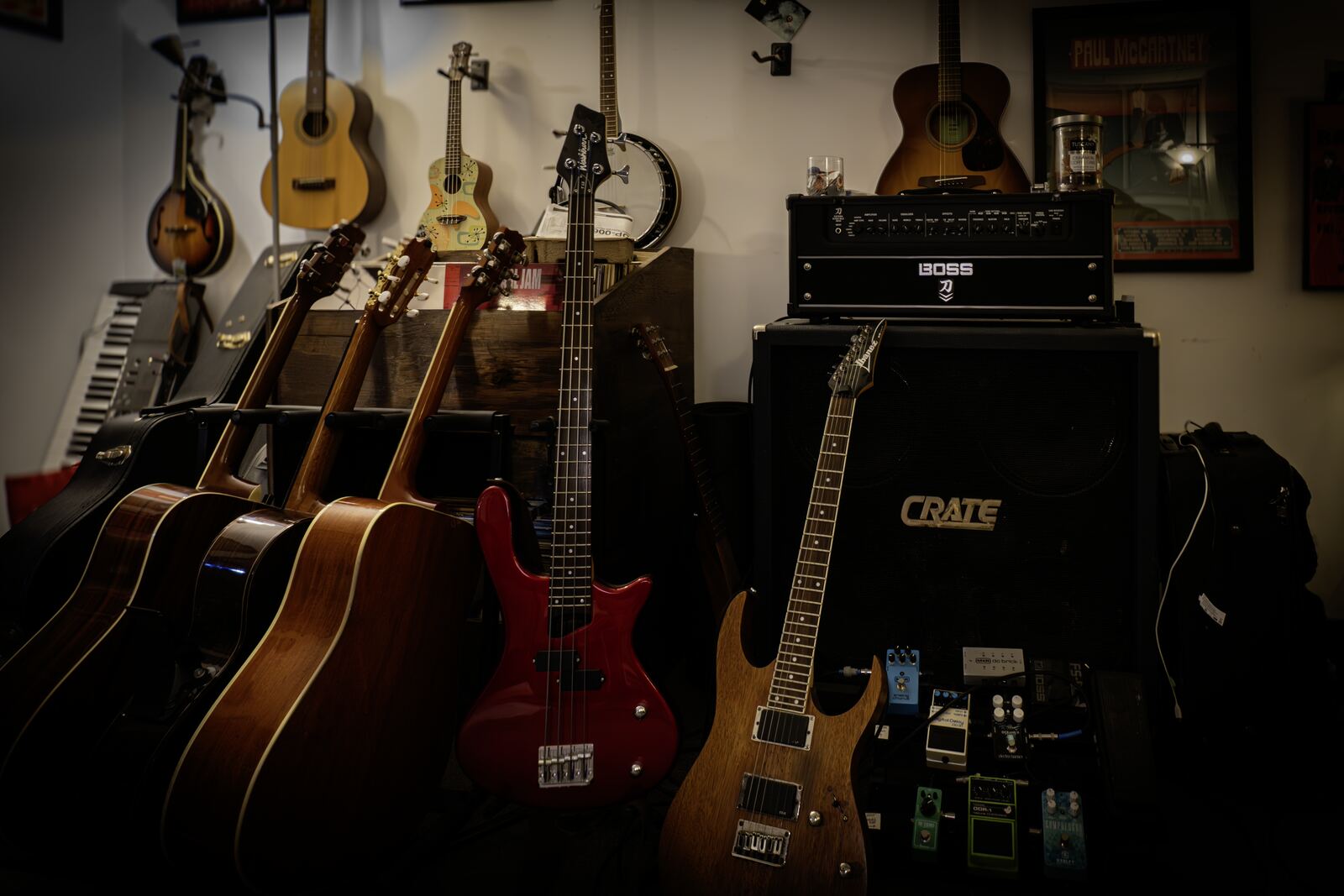
Folk and acoustic playing is mostly accompaniment: an acoustic instrument supporting a voice and a song. It asks for steady rhythm, clean chord changes and a right hand that can strum or fingerpick, often while singing. It is taught on acoustic guitar, mandolin, banjo and ukulele.
Chords, strumming and the capo
Open chords use open strings within the first few frets: G, C, D, E, A and their minor forms. Most folk songs need only a handful of them, and quick, clean changes matter more than a large chord vocabulary.
Strumming patterns combine down- and upstrokes in a steady arm motion, with accents and skipped strokes giving the rhythm its shape. A capo clamps across all the strings at one fret and raises their pitch, so the same open-chord shapes play in a higher key to suit a singer's range.
Fingerpicking
In fingerpicking the thumb and fingers pluck individual strings. Travis-style picking, with a thumb that never stops alternating between two bass strings, is the classic folk pattern; there is more on it on the fingerstyle guitar page.
Open tunings
| Tuning | Strings, low to high | Character |
|---|---|---|
| Standard | E A D G B E | what every other tuning here is measured against |
| DADGAD | D A D G A D | a resonant, drone-heavy sound common in Celtic and modal folk |
| Open G | D G D G B D | the open strings sound a G major chord; common for slide |
| Open D | D A D F♯ A D | the open strings sound a D major chord |
Singing while playing
Singing and playing together depends on the instrument part becoming automatic first. The usual method is to learn the chord changes and strumming or picking pattern until they need no attention, then add the vocal line one phrase at a time.
Mandolin, banjo and ukulele
- Mandolin: eight strings in four pairs, tuned G D A E like a violin. It plays melody and, in bluegrass, the chop, a short off-beat chord that works like a snare drum.
- Banjo: the drone of its short fifth string and the open G tuning give folk and bluegrass banjo their ringing sound. Its two main styles are clawhammer (a downward strike with the back of a fingernail) and three-finger picking.
- Ukulele: four nylon strings tuned G C E A, usually with a high G, giving the bright, close-voiced sound used to accompany songs.
See mandolin, banjo and ukulele lessons.
Songs and songwriting
Folk is built on songs, and its forms, chord progressions and accompaniment patterns carry straight into songwriting lessons.
How lessons approach folk and acoustic
Bring the songs you want to sing. Bill writes them out with the basic changes and rhythm first, then the picking patterns and fills, and plays along so you get used to holding your part against someone else's. If the song sits too high or low for your voice, that is when the capo comes out.
With nothing plugged in, the body style, the woods and the strings are the whole sound; the acoustic guitars, tonewoods and strings guide covers the basics.
Questions
Should I learn strumming or fingerpicking first?
Most players start with open chords and strumming, because they make songs playable quickly. Fingerpicking follows once chord changes are reliable, and Travis-style picking uses the same chord shapes.
What is DADGAD tuning?
DADGAD tunes the six strings, low to high, to D A D G A D. The open strings form a Dsus4 chord, neither major nor minor, which gives a resonant, drone-heavy sound used widely in Celtic and folk guitar.


